If You Already Know That the Infectious Agent Was Either a Virus or a Prion

past Joseph S. Levine
Bovine Spongiform Encephalopathy (B.S.Due east.), nicknamed "Mad Cow Disease" was as unanticipated as AIDS, and is arguably as insidious. Information technology arose from centuries of relative obscurity in sheep to sweep through British cattle herds with staggering speed. It is caused by an infectious amanuensis whose precise identity is still in dispute. It seems to exist unusually adept at breaking through the biochemical barriers that unremarkably brand information technology incommunicable for illness-causing organisms to jump from i species to another. It has already caused the deaths of at least twenty humans, almost of them young. And it may exist incubating inside an unknown number of people who take consumed British beefiness products over the last decade. These gruesome facts alone make the story worth telling.
Yet this is not just a singular cautionary tale; information technology also provides classic examples of doubt in the process of science, the complex and vital 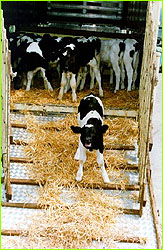 human relationship between science and society, and the office of science in coping with the side-effects of man changes to the environment. Precisely because the construction and general lessons of this story are not unique, we should be careful not to pigeonhole this chain of events as an unfortunate aberration. Here'southward why.
A new infectious amanuensis?
In most textbooks, "the scientific method" is described only as a rational and objective serial of steps that progress incrementally towards a better understanding of the natural globe. Happily, that is sometimes the case, but the procedure of science is not always so linear. The ongoing debate well-nigh the nature of the infectious agent that causes B.South.E. offers a example in point.
The dominant camp asserts that "Mad Moo-cow Illness" and other transmissible spongiform encephalopathies (T.South.Due east.southward) are caused past a new kind of infectious agent: a class of protein called a prion. According to the prion hypothesis, championed by American neurologist and biochemist Stanley Prusiner, this lethal protein tin can be likened to the "evil twin" of a normal protein called PrP, which is present in healthy nerve cells. Somehow, the evil twin molecule is thought to attach itself to a normal PrP poly peptide molecule, convert it into another prion, and echo this operation slowly but indefinitely. Subverted poly peptide molecules adhere to 1 some other, forming clumps called plaques that damage nervous tissue and crusade disease.
Now, to a non-scientist, the notion that affliction can be caused by a naked protein might seem no more or less outlandish than any other revelation churned
| | |
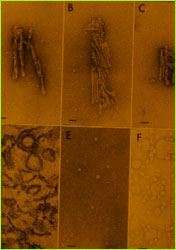 | |
What are the experimental data that atomic number 82 to such heresy? Pickling in concentrated formalin, autoclaving at loftier temperatures, bombardment with intense radiation, and exposure to powerful ultra-violet light all destroy nucleic acids—and inactivate known viruses. However these treatments have no outcome on the ability of the T.Due south.Due east. infectious agent to crusade disease in a new host. Whatever that amanuensis is, information technology is pocket-sized plenty that it cannot be visualized, fifty-fifty past electron microscopes that reveal the tiniest viruses still known to scientific discipline. (Clumps of protein fibrils caused by the plaques that accumulate in cases of T.Southward.Due east. can be seen in electron micrographs, but researchers have notwithstanding to brand positive visual identification of the infectious agent itself.) Furthermore, animals infected by this mysterious amanuensis produce no antibodies confronting it. Even the unusual Human Immunodeficiency Virus provokes an antibody response from the allowed system.
Dissenters to the prion hypothesis contend that Prusiner'south evidence does non add together up to incontrovertible proof that protein alone is responsible for T.S.E.due south. Some postulate the beingness of a unique combination of protein and a tiny piece of DNA or RNA—a combination they call a "virion" or "virino" that is somehow resistant to the treatments that usually destroy nucleic acrid. Others insist that the prion camp has not successfully demonstrated Koch'south postulates. These well-established procedures for positively identifying infectious agents were established by Robert Koch. They include: proving that the agent is present in every instance of the disease; isolating the agent from the host and growing it independently; producing the illness past inoculating a pure civilization of the amanuensis into a healthy host; and recovering the same agent from the experimentally infected host.
Without delving into the largely technical dialogue between these camps, we tin view this situation as an example of how science deals with major shifts in its notion of how the world operates. When such changes in perspective are truly earth shaking—as was Galileo's replacement of an earth-centered view of the solar system with a sun-centered model—they are chosen epitome shifts. They are never fabricated easily, and are frequently surrounded (as they should be) by controversy. (The classic discussion of paradigm shifts in science tin can be constitute in Thomas Kuhn's volume "The Structure of Scientific Revolutions.") Compared to the philosophical repercussions of Galileo's work, the ramifications of Prusiner'southward are relatively minor. Nonetheless, if this work is confirmed, it volition rank among the about important biological discoveries of the 20th century.
The Role of Skepticism
In this example, as in others, scientists view data that do not fit into established models of the earth with skepticism. This skepticism is an integral and essential office of scientific discipline that distinguishes it from other ways of thinking. The function of skepticism in science is to encourage efforts to evidence or disprove a rogue hypothesis. If new findings are upheld, they create a gradually building acceptance that, at some betoken, sparks a transformation in the way scientists think. (The insufficiently sudden acceptance of the prion hypothesis was demonstrated past Prusiner's receipt of the 1997 Nobel Prize in Physiology or Medicine.)
Even afterwards a scientific paradigm shifts, however, dissent from the new model typically persists. In some situations, ongoing dissent is valuable; it may encourage advocates of new views to undertake further, even more all-encompassing and rigorous testing of their ideas. In other situations, continuing dissent can be counterproductive, particularly if it encourages individuals or organizations to base important decisions on demonstrably false logic. In this regard, the attention of the mass media, whose practitioners are often marginally literate in science, can be either a approval or a curse. The journalistic imperative to seek out an stance from an opposing point of view sometimes offers disproportionate weight to contrary pronouncements past marginal thinkers.
Parallels with AIDS
In some means, the recent history of investigations into the cause of T.S.E. parallels that of another recent "mystery" disease—AIDS. In both situations, a radically new and previously unknown infectious agent was involved. In both
| | |
| |  |
Furthermore, in the case of AIDS, every bit in that of T.S.E.s, some debate concerning crusade and upshot withal lingers. Virtually all clinical researchers and epidemiologists who actually work with AIDS concur that HIV is its root cause. Simply a pocket-size, dedicated core of academic dissenters, led by two highly regarded researchers, continues to disagree—arguing, in part, that Koch's postulates have however not been demonstrated for HIV.
Joe Levine is a biologist, educator, and science announcer. He is the author of six books and numerous articles on scientific subjects, and the co-author (with Kenneth Miller) of two widely acclaimed biological science textbooks for high school and college students. Photos: (i) Express Newspapers/Archive Photos; (two) Visuals Unlimited/©Stanley B. Prusiner; (3) Visuals Unlimited/©David Yard. Phillips. When Science Faces the Unknown | 20/xx RetrospectFood Safety Tips | Do Prions Exist?
Teacher'southward Guide | Resource | Transcript | Brain Eaters Home
Editor'south Picks | Previous Sites | Join Usa/E-mail | TV/Web Schedule
About NOVA | Teachers | Site Map | Shop | Jobs | Search | To print
PBS Online | NOVA Online | WGBH
© | Updated November 2000
Source: https://www.pbs.org/wgbh/nova/madcow/faces.html
0 Response to "If You Already Know That the Infectious Agent Was Either a Virus or a Prion"
Post a Comment